
Robledo Family Winery, founded by a man whose father was a Bracero, joins the worst quarter California wine has seen in years.
In a glass case at the Smithsonian’s National Museum of American History sits a hat that belonged to Reynaldo Robledo Sr. Next to it, his tools. Next to those, a label from the 2004 vintage of Los Braceros — the wine he made to honor the Mexican migrant workers who labored in California vineyards under the Bracero program in the 1940s, ’50s and ’60s. His father, Everardo “Lalo” Robledo, was one of them.
On April 8, 2026, Robledo Family Winery, Inc. — founded by Reynaldo and his then-wife, María de La Luz Ramírez, in 1997 — filed for Chapter 11 bankruptcy in the U.S. Bankruptcy Court for the Northern District of California, Santa Rosa Division. The case number is 1:26-bk-10229. The petition was signed by Everardo Robledo, Reynaldo and María’s third child, who serves as the winery’s CEO. The winery listed between $1 million and $10 million in assets and the same range in liabilities, and is proceeding under Subchapter V — the small-business track.
The largest unsecured creditors named in the filings are Kapitus, an Arlington, Virginia-based working-capital lender ([latex]121,370); ILS, Inc. of Rancho Dominguez ([/latex]36,297); and American Express ($36,186). The wine-storage company Winecare Logistics and the forklift dealer Crown Lift Trucks are also on the list. The case’s secured creditor is Unity Bank. Counsel for the debtor is Douglas B. Provencher of Embolden Law PC in Santa Rosa.
A hearing on the winery’s motion for interim use of cash collateral is scheduled for Friday, May 8, 2026, at 1:30 p.m. in San Francisco Courtroom 17, before Judge Dennis Montali. At an initial hearing April 24, the court authorized limited use of cash on a temporary basis pending the May 8 review. Counsel for the debtor, for Unity Bank and for Kapitus Servicing — represented by Brian Harvey — all appeared. Subchapter V Trustee Mark M. Sharf and a representative of the U.S. Trustee’s office, Phillip Shine, were also present.
Reynaldo Robledo Sr. was born in 1951 in Atacheo, a small pueblo outside Zamora, in the Mexican state of Michoacán. He was the oldest of 13 children. His father, Lalo, had come to California in 1950 as a Bracero, stayed on after the program ended in 1964 and eventually legalized his status. On Feb. 25, 1968, at 16, Reynaldo crossed the border with his father and joined him at the Christian Brothers labor camp in Calistoga. The mornings were 38 degrees. He had been used to tropical weather. He spent his first two weeks shivering in an uninsulated bunkhouse warmed by a wood stove. Within two years, he was the vineyard foreman, supervising his cousins, his uncles and his own father.
Over the next two decades, Reynaldo learned the trade by working other people’s land. He developed Les Pierres Vineyard for Sonoma-Cutrer in the 1970s. He worked St. Supéry’s Dollarhide Vineyards in Pope Valley. In 1984, he and María bought 13 acres in Carneros — their first piece of their own — and planted 11 acres of pinot noir. In 1992 they made their first 100 cases of wine. Most of it they gave away — Reynaldo has said he could not get Mexican customers to try it, so he drank a fair amount himself, and some of it made him sick. In 1994 they founded Robledo Vineyard Management. Commercial production under the Robledo Family Winery name began in 1997. In 2003, Reynaldo opened a tasting room — the first in California owned by a former Mexican migrant worker. Mexican President Felipe Calderón visited the winery in 2008. Reynaldo has been to White House dinners.
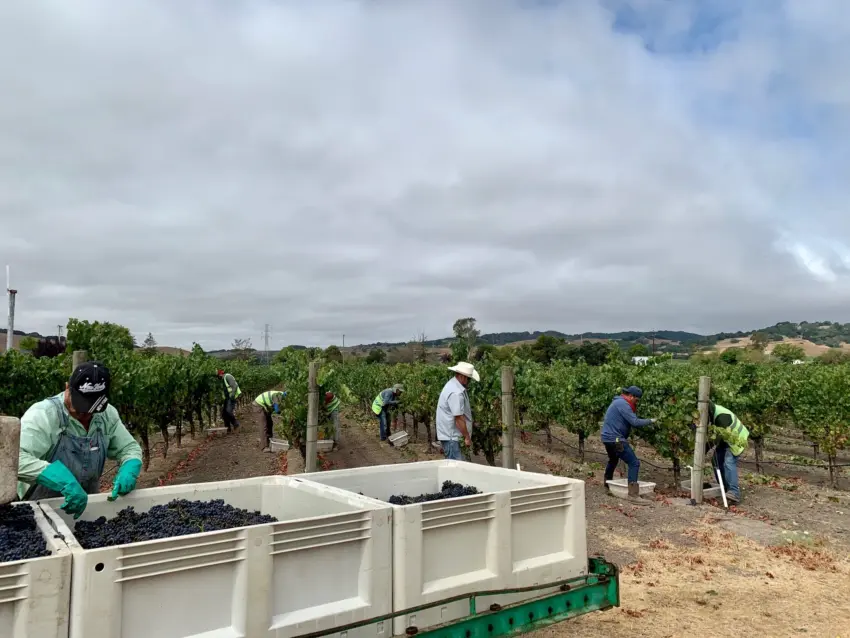
The winery now controls roughly 450 acres across Sonoma, Napa and Lake counties, produces 15,000 to 20,000 cases of wine a year, and farms about 1,200 tons of grapes annually, selling a portion of the fruit to other wineries. The tasting room sits at 21901 Bonness Road in Sonoma. The Smithsonian’s National Museum of American History recognized the family in its “Old Vines and New Blood” exhibit. The Washington Post ran a long Sunday magazine feature on Reynaldo in 2017.
The nine Robledo children have spread out across the wine industry. Lorena, the firstborn, co-founded Napa’s Mi Sueño Winery with her husband, the winemaker Rolando Herrera. Reynaldo Jr. runs The Olive Farm in Sonoma Valley. Everardo, the CEO who signed the Chapter 11 petition, was born in Zamora, Michoacán, in 1975 and was developing whole vineyards by his early teens. Vanessa founded Vanessa Robledo Wine. Jenaro runs Robledo Vineyard Management and Robledo Ranches. The four youngest brothers — Luis, Francisco, Lazaro and Adrian Emiliano — work in production and sales for the family winery.
The Chapter 11 filing concerns one of those many Robledo entities. Whether it ends one is a question for federal court.
The filing comes in the middle of the worst quarter in recent California wine memory.
In January, Constellation Brands laid off more than 200 people at its Mission Bell facility in Madera. In early February, Foley Family Wines & Spirits closed the production facility for Chalone, the historic Central Coast winery, and the Boisset Collection shuttered two Napa Valley tasting rooms. On Feb. 12, Jackson Family Wines filed a Worker Adjustment and Retraining Notification for the closure of its Carneros Hill Winery in Sonoma; 13 jobs went with it. On Feb. 18, Gallo announced it would close its St. Helena Ranch Winery and lay off 93 workers across five North Coast locations, with the cuts beginning in mid-April. Robledo’s Chapter 11 filing came in early April, about two weeks before Gallo’s first round of layoffs took effect.
The four counties Wine Country Daily covers — Sonoma, Napa, Mendocino and Lake — are in the middle of a structural reset. Roughly 38,000 acres of California vineyard came out of the ground between October 2024 and August 2025, according to the California Association of Winegrape Growers; 2,700 of those acres were in Sonoma County alone, 3,100 in Napa. Allied Grape Growers’ leadership now projects another 40,000 or so acres will be pulled in 2026. Statewide wine sales fell from $94 billion in 2020 to $74.3 billion in 2025, a 21% drop, according to Silicon Valley Bank’s State of the U.S. Wine Industry Report.
The big numbers are what frame the Robledo filing. The small ones — $121,000 owed to a working-capital lender, $36,000 owed to a freight company, $36,000 on a credit card — are what end family wineries.
Chapter 11 is not a closure. Subchapter V is a reorganization track, designed for small businesses with under $7.5 million in non-insider debt to keep operating while they restructure their finances under court supervision. The plan timeline is accelerated. The tasting room remains open. The 2024 vintage is still in barrel. Everardo continues to sign court papers as CEO.
A name the Smithsonian thought worth preserving is now in front of a federal bankruptcy judge in San Francisco, asking permission to pay its bills. The May 8 cash-collateral hearing is the next milestone. Under Subchapter V, the reorganization plan itself has to move within months.
Reynaldo Robledo’s American story is bigger than this one winery. The Smithsonian display doesn’t come down because of a Chapter 11 filing, and the wider Robledo footprint — Mi Sueño, Vanessa Robledo Wine, The Olive Farm, Robledo Vineyard Management, the 450 acres across three counties — keeps going. But this brand depends on a courtroom in San Francisco, and on whether the Robledos can do what California’s mid-tier family wineries are increasingly being asked to do: stay wineries in an industry that no longer reliably wants their wine.
—
Roger Coryell is the editor and founder of Wine Country Daily. He can be reached at roger@rogercoryell.com.