

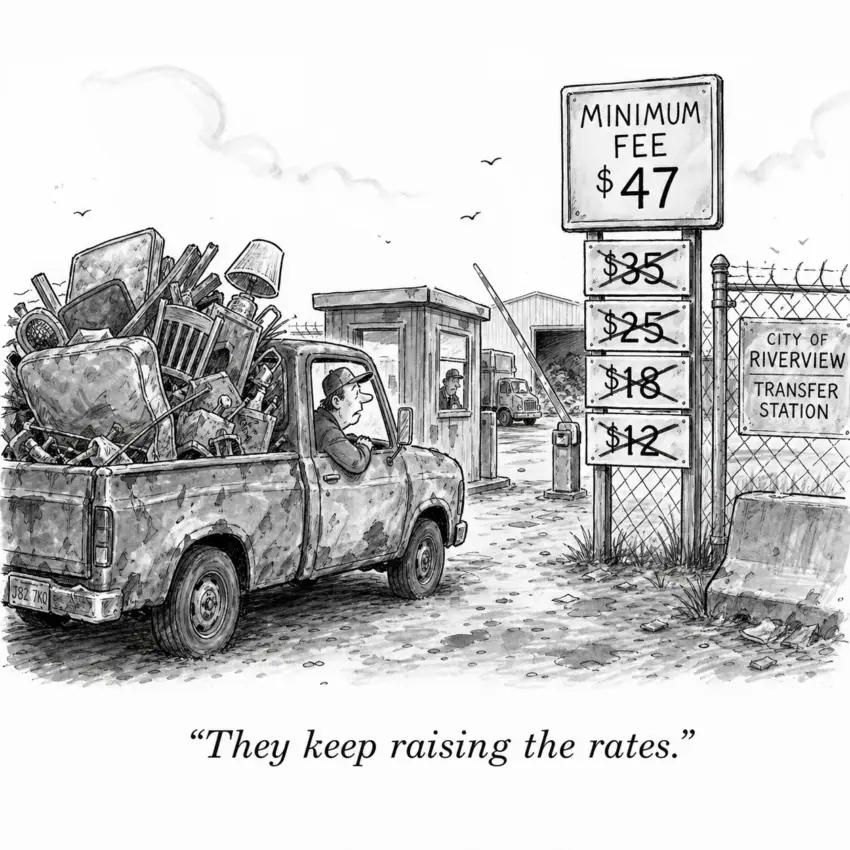
By design, Sonoma County’s $47 dump fee is a customer-acquisition strategy for Republic and Recology
When I moved to West County twelve years ago, dropping a load of yard trimmings at the Pocket Canyon transfer station cost $7. Today the minimum charge for the same vehicle, at the same gate, is $47. The per-ton rate over those twelve years has climbed roughly with inflation. The minimum has climbed almost nine times faster.
That gap between the per-ton rate and the minimum is the entire story, because it tells you who the policy is built for.
A commercial truck rolling into the Central Disposal Site outside Petaluma with five tons of compacted garbage pays $179 a ton, or about $895, and never sees the minimum charge. A homeowner with three bags of trimmings pays $47 to drop forty pounds, an effective rate north of $2,300 a ton. Same posted schedule, twenty times the per-pound cost for the resident.
The fee is not inefficient. It is designed to steer residents away from the cheap public option and onto the expensive private one.
“The minimum fee is designed to encourage residents to use regular waste collection services, which are more environmentally friendly and efficient,” J. Glenn Morelli, Sonoma County’s integrated waste operations division manager, told me in October 2024, when I was reporting on the Pocket Canyon reuse center for the Sonoma County Gazette.
“Regular waste collection services” means Recology and Republic Services — the two contracted haulers who run the curbside bins your city already pays them for. Morelli’s sentence, read carefully, is the agency on the record explaining that the floor at the public dumps exists to push self-haul customers onto private contracts.
Who pays and who collects
Republic Services operates the five publicly owned transfer stations under contract — Central Disposal in Petaluma, plus the smaller stations at Annapolis, Guerneville, Healdsburg, and Sonoma. Republic also holds curbside collection contracts in much of the county. Recology covers the rest: Santa Rosa, the Sonoma Valley, and most of the urban grid where residents have a green and blue bin at the curb every week.
The county’s minimum-fee escalation produces a clean transfer of customers from one revenue line to another. Every homeowner who looks at a $47 charge and decides to subscribe to curbside service instead becomes a recurring monthly bill on the books of one of those two companies. Every small contractor who used to swing through Pocket Canyon with the day’s tear-out — drywall offcuts, wood scraps, a busted toilet — now either eats the $47 hit per stop, builds it into job estimates, or stops going. Curbside doesn’t take construction debris, so the contractor’s options narrow to commercial roll-off service from, again, Republic.
The pattern at the public schedule rewards heavy commercial volume and punishes irregular small loads. That is exactly the customer profile of homeowners and small trades: drop a half-pickup once a month, leave. The schedule is built so that pattern is the most expensive way to dispose of waste in Sonoma County, by a factor of twenty per pound.
The numbers, on the documentary record
The Wayback Machine retains what county websites would prefer to forget. From the agency’s own schedules, archived and current:
| Year | Minimum per vehicle | Garbage by weight |
|---|---|---|
| 2010 | not stated | $108 / ton |
| Nov 2015 | $5.00 weighed (Honda Civic flat: $17.25) | $115.00 / ton |
| Apr 2017 | $10.00 weighed / $15.00 per vehicle | $117.50 / ton |
| Apr 2018 | $25.00 per vehicle | $118.50 / ton |
| Oct 2024 | $40.00 per vehicle (Gazette, Oct 2024) | climbing |
| Apr 1, 2026 | $47 per vehicle |
Per-ton garbage went from $115 to $179 in eleven years — a 56% increase, a hair above CPI. That is what an inflation-driven fee schedule looks like. The minimum charge in the same span went from $5 to $47, a 840% increase. That is not inflation. That is engineering.
I captured the comparison in the Gazette last October: minimum fees had risen 470% for self-haulers against a 30% increase for waste companies over the decade. Commercial haulers fill their trucks before they ever weigh in, so the minimum never touches them. Residents trip it on every visit.
The county also restructured the schedule itself to remove the cheaper paths residents used to have. Until April 2017 a small passenger vehicle paid a flat fee that recognized vehicle size — a Honda Civic was charged differently than a contractor truck. By 2017 the tiers were eliminated and everyone arriving at the gate paid the truck floor. Categories that used to be free — non-freon appliances, CRT televisions, computers — moved to paid columns. Each restructuring tightened the squeeze on the small irregular load.
The cost the agency does not advertise
Russian Riverkeeper estimates Sonoma County spends roughly $500,000 a year cleaning roadside and forest dumping. That cost lands on the general fund — meaning every property tax payer in the county subsidizes the cleanup, including residents in cities that already pay full curbside service and never visit a transfer station. The waste agency’s policy to push self-haulers off the public dumps generates a documentable externality, and the bill for that externality is shifted to taxpayers as a class.
Meanwhile the contracted haulers — Republic and Recology — collect both ways. Republic earns operating revenue at the transfer stations themselves, regardless of what the residential schedule looks like. The schedule that punishes residents at those gates funnels exactly the customer base both contractors most want — recurring monthly subscribers — into their curbside revenue line. The fee policy is, in plain financial terms, a customer-acquisition mechanism the public sector runs at the public’s expense to deliver subscribers to two private firms.
In June 2010, Sonoma County’s then-deputy director of Transportation and Public Works Susan Klassen offered the Press Democrat a candid line about the math: “The better we do at recycling, the less revenue we have to support recycling and other programs. It’s what they call the death spiral.” Sixteen years later, the death spiral has been monetized. The spiral itself is the business model.
Where the franchise fees actually go
The County is not a neutral steward of the structure. It is a financial beneficiary, and the Board has said so on the record at the highest level.
In its formal response to the 2017 Civil Grand Jury — approved as Item 4 on the September 19, 2017 Board agenda and transmitted by Board Chair Shirlee Zane to the presiding judge of the Sonoma Superior Court on September 26, 2017 — the Sonoma County Board of Supervisors wrote, defending the no-bid 20-year franchise the Grand Jury had flagged as “unusual”: “the Refuse Franchise Fee Agreement secured the collection of franchise fees over a 20 year period that result in $3 million annually. In FY 2012-13, the Board committed to designate an annual contribution of $2.2 million in franchise fees to augment the General Fund contribution toward pavement preservation of County roads, and address the accelerated road degradation caused by garbage trucks to rural roads.”
That is the Board, in writing, in 2017. Three million dollars a year in franchise revenue. Two-point-two million of it designated by Board commitment four years earlier as a recurring contribution to road repair. Recology, which inherited the original Ratto Group franchise in late 2017, pays the County 11 percent of its gross franchise revenue under that contract. Higher residential gate fees push residents into curbside subscriptions. More subscriptions, more gross revenue. Eleven percent of more gross revenue is a bigger check.
The line item that funds road repair in Sonoma County is, by the Board’s own pen, partly fed by the residents priced out of the County dumps. The $500,000 a year the general fund spends cleaning up roadside dumping is the externality. The $2.2 million flowing the other way — committed by Board resolution since FY 2012-13 — is the rebate. The County collects on both ends of a structure that converts public-dump customers into curbside subscribers.
That admission, signed by the Board itself, ought to settle the framing question Lukacs’s and Morelli’s responses leave open. The County has a documented financial interest, declared by its governing body in writing, in the rate structure that prices residents off the public option.
Who actually sets the fee — and who shrugs
The two public agencies whose names sit on the gates of Sonoma County’s five public dumps had a press inquiry on this question for a week. Their answers describe an arrangement in which nobody at the public agencies oversees the price residents pay. The actual price-setter is the private contractor that operates the gates.
Start with Zero Waste Sonoma. It is the joint powers authority a Sonoma County resident would naturally call about a dump fee. It has an executive director, a board, a Zero Waste Program Manager on staff, and a .gov website that publishes the fee schedule at zerowastesonoma.gov/disposal-options/central-disposal-site-transfer-stations-fee-schedule. On April 28, Wine Country Daily sent the agency’s executive director, Leslie Lukacs, a press inquiry with six specific questions about the structure of the fees on her website. Lukacs replied with a 130-word disclaimer.
“Zero Waste Sonoma does not oversee self-haul fees, nor are we involved in our member jurisdictions’ franchised agreements with haulers such as Republic Services or Recology. As a result, we have not conducted a financial analysis of minimum fee structures related to self-hauling, tiered vehicle pricing, or curbside subscriber rates. These types of services and pricing decisions are managed at the local jurisdiction level or through individual franchise agreements with haulers, and they fall outside of ZWS’s authority and responsibilities.”
She did not answer any of the six questions.
Asked whether the “designed to encourage” framing — the line her own division manager gave the Press Democrat last fall — represents the agency’s official position: no answer. Asked whether ZWS had studied the fiscal effect of the minimum-fee structure on Republic’s and Recology’s curbside subscriber counts since 2017: no analysis to share. Asked whether the agency had ever looked at the relationship between minimum-fee hikes and the documented rise in roadside dumping that costs the general fund $500,000 a year: no study done. Asked why the schedule moved off the older tiered model that distinguished passenger cars from contractor pickups, and on whose recommendation: no record provided. Asked whether the seat allocation that gives the unincorporated Russian River corridor zero direct vote on the JPA was under any review: no comment. Asked whether the agency was considering a return to tiered pricing for the April 2027 rate cycle: no comment.
Look at what ZWS says it is. The agency’s own About page describes Zero Waste Sonoma as the joint powers authority “for the unincorporated area and nine cities and towns in Sonoma County.” Its stated mission is “to empower personal action in waste reduction and materials management by implementing practical solutions to protect our natural resources.” Its stated purpose is “to serve and help the residents and businesses of Sonoma County reduce, reuse, recycle, and discard all materials in the safest and most environmentally responsible way possible.” Its staff, the page says, “conduct solid waste planning.”
A residential fee that prices residents off the public dumps and into roadside dumping that costs the general fund half a million dollars a year to clean up is the question of how Sonoma County residents discard materials in the safest and most environmentally responsible way possible. It is the question at the center of the ZWS brief. Lukacs’s response is that her agency has not studied it, has no view on it, and considers it outside her agency’s responsibility.
That is the regional waste authority telling a reporter, in plain terms, not our circus, not our monkeys. It is also the regional waste authority defining its job description down to nothing on a question its charter says it exists to answer.
The missing analysis is its own finding. ZWS, by Lukacs’s account, has not studied whether an 840 percent escalation in the residential floor at the public dumps is increasing illegal dumping, diverting hazardous waste off the tipping floor, or shifting e-waste from the public stream into roadside ravines. The agency named Zero Waste has not pressure-tested its own pricing against the documented externality the pricing produces.
So who does set the fee? J. Glenn Morelli, the county’s integrated waste operations division manager and the source of the “designed to encourage” line, named a section of a contract. The minimum charge at the publicly owned transfer stations, he wrote on May 4, is not adopted through any county fee process. It is set by the contractor that operates the gates:
“Under Section 11.3 of the MOA, self-haul rates are set independently by Republic, in its sole discretion. The minimum charge reflects Republic’s estimation of the appropriate market price for that per-transaction service.”
The county, Morelli added, “does not annually adopt Republic’s transfer station self-haul rates through the County’s general fee schedule process.”
Two clean disclaimers, one on top of the other. The JPA residents could lobby — ten seats, nine city representatives and one county supervisor (currently Rebecca Hermosillo of District 1, with Trish Pisenti as alternate) — says it does not set the minimum and has not analyzed it. The county, which owns the facilities, says its general fee process does not adopt the minimum either. The minimum is set, “in its sole discretion,” by Republic Services, the private contractor whose curbside-subscription line directly benefits when residents are priced off the public dumps and steered onto a monthly bill.
Lynda Hopkins of District 5, the supervisor whose district covers Pocket Canyon and the Russian River corridor where self-haul reliance is heaviest and who has fielded constituent complaints on the fee for years, has no seat on the JPA either. The county’s lone seat is held by a north-county supervisor whose district has full curbside coverage. The seat that could vote for rural self-haulers does not exist.
A fee charged to the public, at publicly owned facilities, set by a private contractor in its “sole discretion,” converts the residents who balk at the gate into recurring monthly subscribers on the same contractor’s other ledger. Every public agency in the chain has, in writing, declined to claim the per-transaction price as its decision. The only entity willing to take credit is Republic, in a section of a contract most residents will never read.
What the contract actually permits
The MOA most residents will never read is the 2013 Master Operations Agreement between Sonoma County and Republic Services of Sonoma County, Inc. — 25 years of committed waste, signed April 23, 2013, effective for the cities April 1, 2015. Four provisions explain how Republic ended up with sole discretion over a fee at facilities the County still owns.
§11.3 — Sole discretion on self-haul. “Subject to Section 11.5, the Contractor Service Fees established for Self Haul Waste and Construction and Demolition Waste shall be determined in the sole discretion of the Contractor.” Republic, not the County, names the price for residents at the gate.
§11.4(A) — A 3.5 percent annual cap on commercial fees. Commercial and city-committed rates “shall be increased annually… by ninety percent (90%) of the twelve month average increase, if any, in the CPI, provided, however that, such adjustment shall not exceed three and one-half percent (3.5%) in any one year.” Commercial rates are mathematically leashed to inflation. Residential self-haul rates are not.
§11.5 — The parity cap that does not reach the floor. Republic’s discretion under §11.3 is “subject to” §11.5, which says: “Contractor’s Service Fees for a given category of Self-Haul Waste shall not be more than five percent (5%) higher than the Contractor Service Fees to the County and Committed Cities for that category of Waste.” Reasonable on its face. The hole is in the words for a given category. The cap applies to per-ton rates within named waste categories. It does not reach the per-vehicle minimum, which is a per-transaction floor — not a category. Republic’s discretion to ratchet that floor is uncapped; the parity test never engages.
§11.4(D) — Most Favored Customer Clause, and who is left out of it. The MFC clause caps what Republic can charge “any public agency within Sonoma County for the delivery of Waste” to the County dumps. The carve-out at the bottom is the line that decides who is protected: “It shall also not apply to Self Haul Waste that is not generated by a public agency.” A city dropping off waste at a county dump enjoys most-favored-customer protection. A private resident dropping off the same waste at the same dump does not. The contract says, on the page, that residents are second-class customers.
Together, the four provisions explain the asymmetry. Residential self-haul is set by Republic in its sole discretion, with no inflation cap, with the parity test scoped narrowly enough to miss the per-vehicle floor, and with the resident explicitly carved out of any most-favored-customer guarantee. The gap between the commercial truck and the resident at the gate is not the product of clumsy rate-setting. It is what the contract was written to permit.
The audit the Board chose not to require
In June 2017 the Sonoma County Civil Grand Jury issued Loss of Composting in Sonoma County, a 21-interview report on how the County had ended up with the 25-year MOA, what the Grand Jury called “an unusual, no bid, 20-year Franchise” for the Ratto Group, and a $2.5-million-a-year out-of-county composting bill after Sonoma Compost was permitted out of existence in April 2015. The Grand Jury made three recommendations. The first, R1, was directed at the Board of Supervisors: “When entering into long-term agreements, the Board of Supervisors require independent audits be done every three to five years to insure the terms remain fair to all parties to the agreement.”
The Board did respond. In the packet approved as Item 4 on its September 19, 2017 agenda and transmitted to the presiding judge of the Sonoma Superior Court by Board Chair Shirlee Zane on September 26, 2017, the Board’s response on R1 reads, in part:
“Recommendation R1 has not been implemented and will be implemented in the future… The County has not established a policy that facilitates independent audits on long term agreements… The purpose of reopener clauses is to allow parties to renegotiate certain terms of the agreement under unusual circumstances and to ensure the original bargain is maintained. Allowing renegotiations on the basis of fairness can be broad reaching and could potentially jeopardize the contractual relationship. The County will however assess requiring independent audits for compliance of long term agreements as part of the annual review of its Services Agreement Policy.”
The Board, writing to a presiding superior court judge in formal response to a civil grand jury, told the court that audits-for-fairness on the County’s long-term agreements were a policy the County preferred not to adopt, on the stated grounds that they “could potentially jeopardize the contractual relationship.” The relationship being protected, in the case of Loss of Composting, was the 25-year MOA with Republic Services.
That is not a Board failing to respond to a grand jury. It is a Board explaining, in writing and on the record, that it weighed the value of an independent fairness audit against the comfort of its contractor — and chose the contractor.
What the Board has done since is the more useful question. Asked directly whether any independent audit of the MOA has been conducted in the nine years since the Grand Jury report, Morelli’s May 4 letter named one 2017 internal compliance review by the Auditor-Controller-Treasurer-Tax Collector — covering April 1, 2016 through March 31, 2017 — and the annual third-party financial audits of the Integrated Waste Enterprise Fund. He continued: “I do not have a record of any other audits of the MOA.”
The Grand Jury asked for an independent audit of the long-term agreement every three to five years. Nine years on, none has been conducted. The 2017 Board response — the policy choice not to audit, on the stated grounds that an audit might jeopardize the contractor relationship — has held. The contract paragraph that puts residential self-haul in Republic’s sole discretion has, by Lukacs’s, Morelli’s, and the 2017 Board’s combined accounting, no reviewing body and no scheduled review. Not the JPA, which disclaims authority. Not the County’s general fee process, which does not adopt the rate. Not an outside auditor, because none has been commissioned and, by Board choice, none will be. Republic is policed by its own discretion, and the County has put that arrangement in writing.
The pattern holds in the present tense. On April 29 I filed a California Public Records Act request with the Clerk of the Board, asking for any records of a Board action adopting the April 1, 2026 fee schedule — the action Morelli’s May 4 letter said had not occurred through any County fee process. The Clerk’s office, Administrative Aide Leslie Granados, replied this afternoon. The full response: “Records responsive to your request are available via search in Legistar and Board of Supervisors Records Archive.” That is not a determination as to whether disclosable records exist, the threshold the California Public Records Act requires under Government Code §7922.535. It is an instruction to search the County’s online archives on my own for any record of an action the County’s own waste division manager has said did not happen. Two County offices, in different language, both told me to go elsewhere.
What the agency owes the public
Three numbers Zero Waste Sonoma should be required to publish before the next April rate vote:
- The actual revenue Republic Services and Recology receive from county and city contracts, broken out by self-haul tipping fees vs. curbside subscription receipts, for the period 2014 to present.
- The agency’s internal modeling, if any, of the relationship between minimum-fee increases and illegal dumping volumes — and the net fiscal effect after the $500,000-per-year cleanup transfer.
- The number of new residential curbside subscribers added in each city since 2017 — the period over which the minimum fee tripled — and what share of that growth the agency attributes to the self-haul fee structure.
If the fee floor is in fact “designed to encourage” curbside enrollment, the design has paid customers attached to it. Those customers are subscribers in someone’s revenue projection. The public is owed the numbers.
The fee keeps climbing, each April brings another increase, and each public agency in the chain has said in writing that the rate is not theirs to set. ZWS disclaims authority. The County’s waste division does not adopt the rate through its general fee process. The Board, as a matter of stated policy, will not require an audit because an audit might unsettle the contractor. The Clerk of the Board, when asked to produce records of any Board action adopting the schedule, sends the requester to the online archives. Republic, which does set the rate, profits from the residents who, faced with $47 at the gate, sign up for a curbside subscription instead. Recology profits the same way on the city side. The County collects 11 percent of both haulers’ gross franchise revenue. What does not make it into either system ends up on the back roads of west county, and the cleanup is billed to taxpayers as a class.
When I drive past Pocket Canyon now, the gates are open from 8 a.m. The line is sparser than it used to be. Some of the missing customers are now Recology subscribers. Others are dumping their load on a back road or in a west county streambed, where Sonoma County taxpayers pay half a million a year to clean up after them. Either way, they are no longer paying the public dump.