

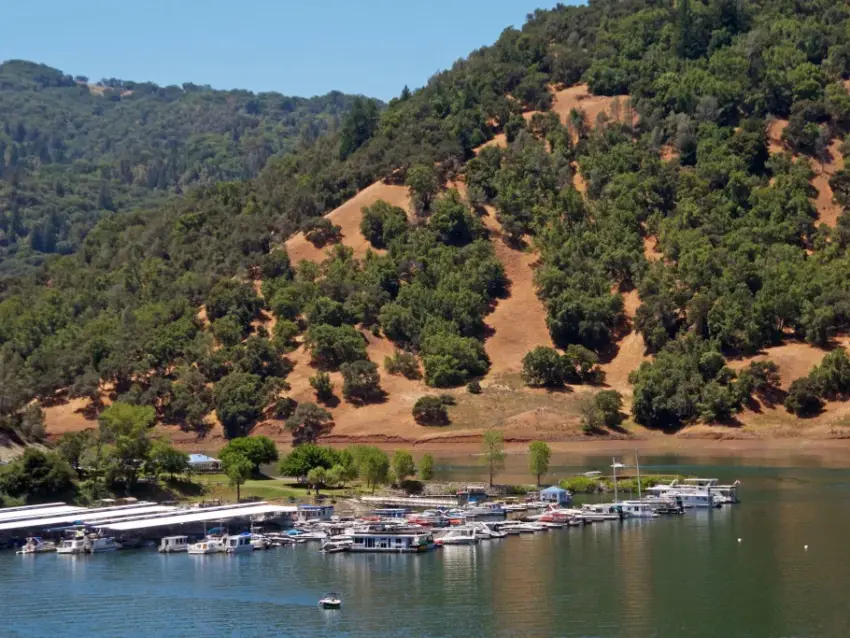
For forty years, the Sonoma County Board of Supervisors voted every spring on the same small contract — Sheriff’s deputies patrolling Lake Sonoma from May through September, paid back by the U.S. Army Corps of Engineers. They asked questions. They kept watch. This spring the vote didn’t happen, and it won’t happen again. The contract slipped by in the dark.
Not corruption. Nothing nefarious. The boats are still on the lake. The deputies are still on the boats. The Corps is still cutting the check. By every measure you can see, this summer at Lake Sonoma will look like last summer, and the one before, going back to 1985. Last year’s contract capped at $281,903. Small money in county terms.
The only thing missing is the vote — and the door it used to keep shut.
It came back to the board one last time on June 3, 2025, the way it always had — Item 46 on the consent calendar, file #2025-0568. But the staff packet carried an extra paragraph that year. Tucked alongside the year’s renewal was a separate resolution that did something the board had not been asked in four decades. It would hand the Sheriff-Coroner ongoing power, in consultation with County Counsel, to sign every future Lake Sonoma agreement on his own. The contract would still be public. The supervisors would no longer be voting on it.
Forty years of yearly votes, and then this.
The case for the hand-off, in the staff exec summary, was efficiency. The contract had come back nearly word-for-word every year since 1985. The summary asked the board to “streamline routine administrative procedures and workflows in line with the Board’s Strategic Plan.” The Strategic Plan field on the legislative record itself reads N/A. The pitch shows up in the talking points, not in the box on the form that would tie this hand-off to a real strategic goal.
The item went through on consent. The Legistar entry reads “Approved as recommended.” The audio backs up what the entry says. Across the roughly forty-eight minutes the board spent on consent that morning, the words Army Corps, USACE, and Marine Unit were not spoken once. “Lake Sonoma” came up a single time — and not for this item. A supervisor used the phrase to praise an unrelated Sonoma County Water Agency contract for precipitation radar at Mt. Barnabe, Item 53 on the same agenda. Other consent items drew dais comment that morning: tourism-fund grant awards, a towing contract, a sustainable-agricultural-lands grant, the radar contract. Item 46 — the standing hand-off — drew none. The Sheriff’s Office staff contact was Jeff Bean. The Sheriff himself, Eddie Engram, was in the audience.
So that is what changed, and that is how it changed. Now the what-if.
This is where the boats matter less than the office. The Sheriff who now holds standing power over the Lake Sonoma agreement is Eddie Engram, and Engram has not been quiet on the question of oversight. He has, on the record, threatened Supervisor Lynda Hopkins. He has fought Measure P, the oversight law Sonoma County voters passed in 2020 to put real teeth in the Independent Office of Law Enforcement Review and Outreach (IOLERO). His office has worked, in court and in practice, to keep IOLERO from doing what voters told it to do. Those are not claims buried in a lawsuit. They are the public stance of the elected Sheriff toward the elected board, and toward the voters who hired both of them.
Set against that record, the June 3 hand-off reads differently. It is not just a shortcut around forty years of routine renewal votes. It is a small but real piling-up of sign-off power — the right to sign a recurring federally paid-back agreement, the right to talk over the substation license that comes with it, the right to handle whatever the Corps wants to change next year — handed to an office whose chief is on the record fighting the idea that the rest of county government should be able to check him. The dollars are small. The pattern is not.
The case against any standing hand-off in waters this routine — that “functionally a renewal” can change if nobody is watching — stops being a what-if when the office holding the pen has already shown what it does when somebody tries to watch. The Corps could fold patrol boundaries into a different unit. The pay-back schedule could shift. The five-year property license that gives deputies a substation, a storage container, and dock space at no cost ran out August 1, 2025; its renewal was not laid out in the June 3 materials. Under the new hand-off, the board would not see that license again either. The Sheriff would not have to bring it back, and the Sheriff has, in other fights, shown what “not have to” means in practice.
The check that survives is the phrase “in consultation with County Counsel.” Counsel reviews what is lawful. It does not review what is wise, and it has no power to force a Sheriff who has already chosen, elsewhere, not to be forced. If a future signing carried a real change in the deal — a different patrol footprint, a smaller pay-back floor, a new substation license on worse terms for the county — Counsel would not be the body to flag it. The supervisors would have been, until June 3, 2025.
There was a second small thing about that meeting, easy to miss. The contract had already taken effect May 9, 2025. The board was asked to ratify it on June 3. The Sheriff’s Office had been working under Corps-funded power for nearly four weeks before the body that holds the purse strings had voted on the terms. That gap is normal for routine renewals. It is also harder to push back on once the board has handed the renewals off for good.
This isn’t the kind of item that makes a headline by itself. It is the kind that quietly walks out one of the basic checks of a county board, and does it on behalf of an officeholder who has already, in public, said he wants fewer such checks. A consent vote is still a vote of trust: we trust this is routine, someone has read it, nothing was slipped in that shouldn’t be there. A standing hand-off ends that trust for good. It says we no longer need to check. It says it to a Sheriff who has, in other rooms, said back: good.
The boats are on Lake Sonoma again this summer. The deputies are paid by the Corps of Engineers. The county is getting the work done, and the public is safer for it. None of that was ever the question. The question was whether the supervisors would still be the ones signing off — and on a contract this small, with a partner this steady, the easy answer was always yes, of course, why bother. The harder answer is that you don’t pile authority into an office that has shown it doesn’t want to be checked. You don’t need a scandal to make that point. You only need a record. Sonoma County has one.