

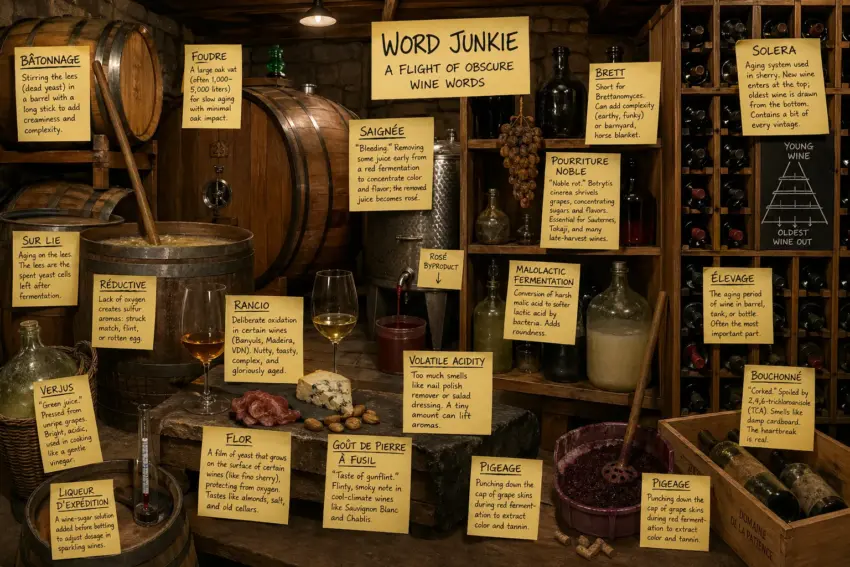
The bâtonnage is done, the foudre is breathing, and the cellar smells like rancio, brett, and Tuesday. The pourriture noble has set in on the late-pick Sémillon, gloriously and on purpose, and somewhere in the back a saignée tank bleeds off rosé like a politely punctured artery. (Roger Coryell / Wine Country Daily)
Wine has more vocabulary than it needs. That is part of what makes it fun.
You can drink the stuff for years and get by with about thirty words. Red, white, rosé, dry, sweet, oaky, jammy, corked, expensive. That’ll cover any tasting room from Healdsburg to Sonoma. But there’s a basement under all that — a half-French, half-Latin, occasionally Catalan layer of terminology that mostly serves no purpose except that once you know it, you cannot un-know it. You will start using “bâtonnage” at a barbecue, and the host will quietly seat you at a different table.
Here are some of my favorites. The kind a winemaker uses with another winemaker after the tasting room has closed, not the kind on the back of a wine-club newsletter.
Bâtonnage. From the French bâton, “stick.” It’s the act of stirring up the dead yeast at the bottom of a barrel — the lees — with a long pole, to give a white wine a creamier mouthfeel and a biscuity nose. Most Chardonnays you’ve sipped on Westside Road have been bâtonnaged at some point. The word also makes a fine verb in English when nothing is actually being stirred. I bâtonnaged the soup. I bâtonnaged the meeting until it had texture.
Brett. Short for Brettanomyces, a wild yeast strain. When a wine writer is being polite, brett produces “barnyard.” When they’re being less polite, it’s “horse blanket,” “Band-Aid,” or “wet saddle.” A whisper of brett can give a Rhône-style red some real character. A lot of it tastes like the inside of a tack room. The natural-wine debate, condensed to two syllables.
Rancio. Catalan and southern French, for the deliberately oxidized, nutty, slightly funky note of certain old fortified wines: Banyuls, some Madeiras, the better Vins Doux Naturels. Imagine a sherry that got forgotten in an attic and improved itself there. Also useful for very old cheese, very old prosciutto, and the better kind of dive bar.
Pourriture noble. “Noble rot.” A polite name for Botrytis cinerea, the fungus that, in exactly the right humidity on ripe Sémillon or Riesling, shrivels the grape, concentrates its sugars, and produces Sauternes, Tokaji, and the late-harvest dessert wines you sip from thimble-glasses while pretending you don’t want a second one. On most crops, a fungus eating the fruit is a disaster. On Sémillon at the right moment, it’s a vacation.
Saignée. “Bleeding.” When a winemaker draws off some juice from a red fermentation early on, mostly to concentrate what remains, with a quick rosé as the byproduct. A surprising number of the better Sonoma rosés got their start as somebody trying to make a denser Pinot. Rosé as collateral generosity.
Foudre. A large oak vat — much bigger than a barrel, often the size of a small office. Used for long, slow aging without the heavy toast and tannin you get out of a 225-liter barrique. The word looks like foudre, French for “lightning.” The two are unrelated, but it’s fun to pretend the secret to your favorite Grenache is that it spent two years inside a thunderstorm.
Verjus. Literally “green juice.” Pressed from underripe grapes thinned out in the vineyard, it tastes like a polite, citric vinegar with a fruity backbone. Cooks use it where lemon would be too sharp and vinegar too rude. Most Sonoma vineyards throw the green-thinning fruit on the ground. A few gather it. The ones who gather it tend to know what they are doing.
Bouchonné. “Corked.” Specifically, a wine spoiled by 2,4,6-trichloroanisole, the compound that makes a bottle smell like a damp cardboard box that lived in a basement. Roughly one bottle in twenty used to come out bouchonné. Modern cork sourcing has cut that down, but you’ll still hit one a year if you open any volume of cork-sealed wine. The word is more elegant than the smell.
Volatile acidity. The wine flaw whose closest chemical cousin is nail polish remover. A trace of VA in the right wine can lift the aromatics. A lot of it and you’re drinking salad dressing. Funky natural-wine fans tolerate VA the way some people tolerate cilantro: passionately, on either side.
Reductive. Wine starved of oxygen during aging develops sulfur compounds that smell like a struck match, a flint, or in the unhappier cases an egg you regret. Decant a reductive bottle for an hour and a good one opens up like a tulip. Some of the best white Burgundies of your life will pass through this phase. Don’t write off the bottle on the first sip.
Goût de pierre à fusil. “Taste of gunflint.” The flinty, smoky note in cool-climate Sauvignon Blanc and Chablis, prized by people who own monocles and feared by people writing tasting notes for the back label. A close cousin of reductive, with better PR.
Solera. A Spanish aging system, used mostly for sherry. New wine is added to the top of a stacked pyramid of barrels, and a small portion of the oldest is drawn off the bottom for bottling. Every glass of an old solera contains a microscopic sip of every vintage that ever passed through it. A handful of California producers have started building soleras. They are patient people.
Flor. A film of living yeast that grows on the surface of fino sherry as it ages, sealing the wine off from oxygen and feeding on it slowly. Looks like a thin gray skin. Tastes like almonds, salt, and the inside of a church. One of the stranger, quieter beauties in wine.
These words do not make you a sommelier. They just let you say what is actually in the glass with a little more precision than “good” or “weird.” That funky orange-ish white from your friend’s garage may have been aged sur lie under a quiet bloom of flor. The ten-year Cabernet you opened last week and almost tossed was probably reductive, and a half hour in a decanter would have rescued it. That bottle of late-harvest Riesling someone brought to Thanksgiving was, briefly and gloriously, attacked by noble rot before it was lifted off the vine.
Pour another glass. There are more words where these came from. Élevage. Malolactic. Pigeage. Liqueur d’expédition. We’ll get to them.