

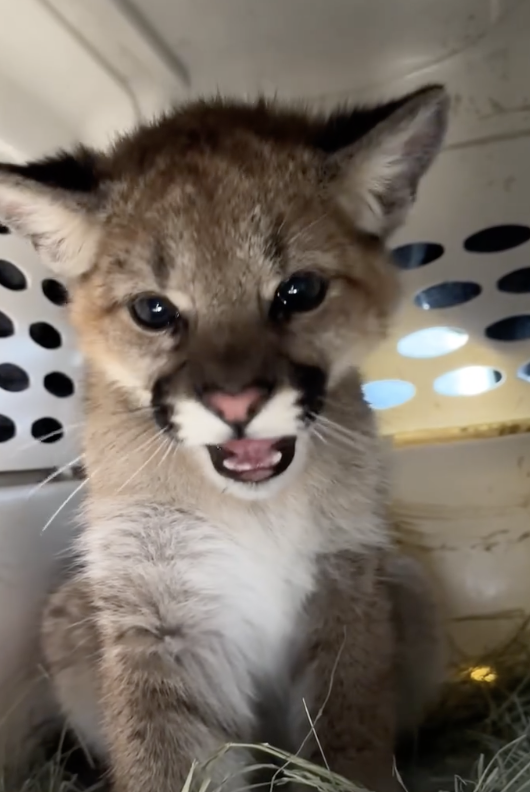
A young female mountain lion who spent the last five months at Sonoma County Wildlife Rescue in Petaluma is back in the wild, after state biologists walked her into a stretch of remote Northern California habitat earlier this month.
She is eleven months old, weighs enough to make her own way, and is missing most of her tail.
The California Department of Fish and Wildlife announced the release on May 8 in a short video posted to its official Facebook channel. The agency did not say exactly where biologists turned the cat loose — predator release sites are routinely withheld so poachers and gawkers don’t follow the GPS rumor mill to a fresh young lion sitting on the side of a logging road. Officials said only that she was returned to “remote habitat in northern California.”
Before they opened the carrier, crew fitted her with an ear tag, a microchip, and a GPS collar. Those three things together mean the next chapter of her life — where she walks, where she dens, whether she finds a territory or gets pushed into trouble — will be on the record. CDFW staff and Sonoma County Wildlife Rescue can read that collar, and so can the biologists studying how young lions disperse through a landscape that is increasingly cut up by roads and people.
How she ended up in Petaluma
The cub came down out of Siskiyou County, not the North Bay. Last fall, residents of Weed — the small lumber town under the south face of Mount Shasta — began reporting a juvenile mountain lion lingering inside the city limits with no mother in sight. In a public notice posted to the city’s website, City Manager Dustin Stambaugh laid out the response: daily camera monitoring along likely travel corridors, coordination with CDFW, and traps staged with a licensed trapper. Stambaugh urged residents to bring pets in at night, secure trash, and report sightings through the state’s wildlife incident system rather than calling around to neighbors.
By November, CDFW officers were able to capture the orphaned lion. She was old enough to have learned some hunting from her mother, but not old enough — or large enough — to be left to push through winter alone in Siskiyou. Wildlife officials moved her to Sonoma County Wildlife Rescue in Petaluma, the nonprofit that runs one of the larger permitted mammal rehabilitation operations in this part of the state and regularly takes federal and state referrals.
Why the tail is gone
Here is the part wildlife agencies tend to talk around, and to their credit CDFW did not: she lost most of her tail in human care, not in the wild.
In its post announcing the release, the department wrote that “trauma suffered during capture and captivity resulted in the lion losing its tail.” Veterinarians and biologists working the case concluded the shortened tail is not a significant handicap, the agency said, and the cub demonstrated before her capture and again during rehab that she could hunt and feed herself.
Mountain lions use their long tails as a counterweight when they pounce and turn at speed. Losing part of one is not the same as losing a leg, but it is not nothing either. The fact that the agency disclosed how it happened, rather than letting “rescued tailless cub” sit there with no explanation, is worth noting.
Petaluma’s quiet role in the predator-care pipeline
For most people in Sonoma County, Sonoma County Wildlife Rescue is the place that takes in injured songbirds, orphaned fawns, and the occasional opossum found behind a garbage can. The mountain lion enclosures sit out of public view. They have to: a young apex predator on the path to release cannot get comfortable with people, or the release will not work. Staff use remote monitoring, limit direct contact, and condition the cat to keep her hunting instincts intact.
That work, mostly invisible from the road on Mecham Road, is part of why CDFW keeps routing big-carnivore cases here. The Petaluma nonprofit has handled bear cubs, bobcats, and now back-to-back young lions — including a separate cub flown up from Castaic in January and still in care.
What happens next
Biologists will watch the GPS collar for weeks, looking for the pattern of a young animal that is moving, hunting, and beginning to claim a piece of country to itself. The collar will eventually drop off; the ear tag and microchip will outlast it. Early signs, CDFW said, are that she is doing what an eleven-month-old lion should be doing — moving on her own and getting back to the business of being a wild cat.
She does not need a name to count as a North Bay story. The hands that fed her, weighed her, and finally let her go are local.
—
Sources / primary documents
- California Department of Fish and Wildlife, release announcement video, May 8, 2026 — facebook.com/reel/2069206464008117/
- City of Weed, “Mountain Lion Monitoring Update and Community Guidance,” City Manager Dustin Stambaugh — ci.weed.ca.us/news-and-notices/mountain-lion-monitoring-update-and-community-guidance/
- Sonoma County Wildlife Rescue — scwildliferescue.org
- Hoodline aggregation, “Tailless Young Mountain Lion Gets Second Shot In NorCal Wild,” May 9, 2026 (derivative, AI-assisted; not cited in piece)
Reporting holes worth closing before publish
- Call SCWR (707-992-0274) for: name of lead caretaker on the case, weight at intake vs. release, was she paired with the Castaic cub in care, any photos cleared for press use
- CDFW Region 1 (530-225-2300, askregion1@wildlife.ca.gov) for: confirmation that the trauma was sustained during the capture event itself or later in captivity, and which agency was holding her at the time
- City of Weed (Stambaugh) for: a closing quote — town’s reaction to her release