

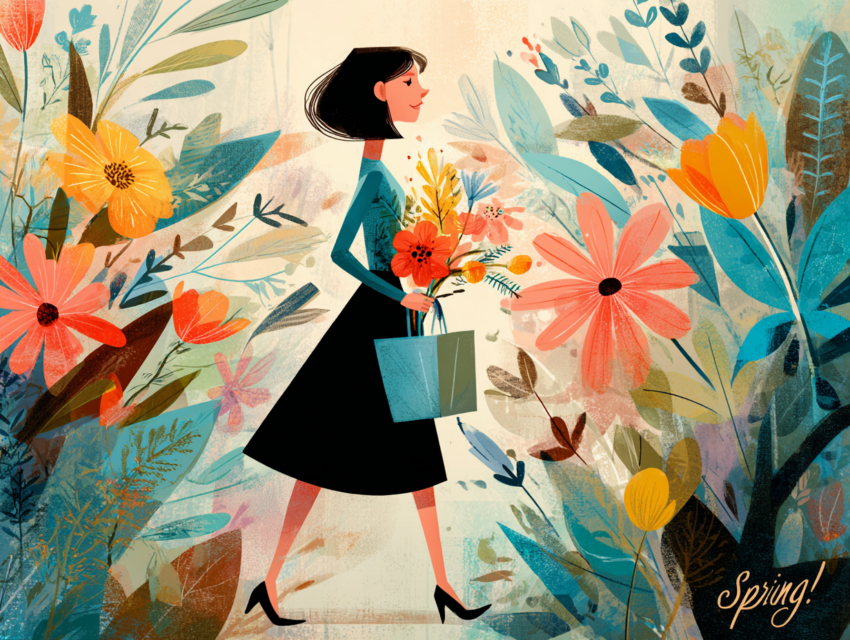
In which we drag a perfectly nice season into a basement of dictionaries and refuse to let it leave
Spring is the season everyone loves and no one can describe without sounding like a greeting card. “Renewal.” “Awakening.” “Rebirth.” Sure. Also: mud, allergies, and the unsettling realization that you have not, in fact, gone to the gym since November. But the words we use for all of it — those are where things get interesting. So pull up a folding chair on the etymological lawn. Let’s dig.
Spring itself, the overachiever
Let’s start with the word doing the most. Spring is one of those English nouns that decided one job was for cowards. It is:
- a season
- a coiled piece of metal
- a place where water comes out of the ground
- what a cat does to a houseplant at 3 a.m.
- a leap, a bounce, a sudden movement
- the start of something
These are not unrelated. They all come from the same Old English root, springan, meaning to leap or burst forth. Water bursts forth from the ground; a season bursts forth from winter; a metal coil bursts forth from compression; a cat bursts forth from a curtain rod. The Anglo-Saxons did not distinguish, and frankly, neither should we. Everything springs. The word is doing yeoman’s work and asks for nothing in return.
Bonus: the season was originally called lent in Old English — short for lencten, meaning “to lengthen,” because the days were getting longer. We kept the religious bit, lost the seasonal bit, and ended up with a word that to most modern English speakers now means “the time of year you give up chocolate.” A demotion, honestly.
April: the month that won’t shut up about itself
April comes (probably) from the Latin aperire, “to open.” This is the month when buds open, eyes open, possibilities open, and your sinuses open in a way you did not consent to. The Romans were not subtle namers. February? Februa, the purification festival. March? Mars, god of war and also, somehow, agriculture. April? “Things are opening, please clap.” Thanks, Rome. Riveting.
There is a competing theory that April comes from Aphros, an alternate name for Aphrodite, which is honestly the explanation I’d pick if I were running brand strategy for the month. “April, brought to you by the goddess of love and sea foam” is a much better campaign than “April, the doors are ajar.”
Vernal, and why your weather app is showing off
Vernal, as in vernal equinox, comes from the Latin ver, meaning spring. That’s it. That’s the whole word. Latin just looked at the season and grunted ver and walked away, and we’ve been stretching that one syllable into adjectives for two thousand years. Every time someone says “vernal,” they are essentially saying “spring-y” with a graduate degree.
While we’re here: equinox is aequi- (equal) plus nox (night). The night equals the day. It is one of two moments per year when the planet stops playing favorites. The other is the autumnal equinox, in September, when you will once again pretend to enjoy pumpkin things.
Bloom vs. blossom, an unnecessary rivalry
A bloom and a blossom are not the same thing, and people who know this will tell you, often. Strictly: a blossom is the flower of a plant that eventually produces fruit (cherry blossom, apple blossom). A bloom is everything else (roses, tulips, your overconfident peonies).
Both come from Germanic roots meaning, basically, “flower.” Blōma in Old Norse, bloma in Gothic. The words bloomed together (sorry) and split jobs sometime in Middle English when, presumably, an orchardist got tired of imprecise terminology and started a fight at the pub.
The verb bloom has also, over the centuries, taken on the meaning of “to come into full beauty or potential,” which is why you can describe both a peach tree and a teenager as blooming and have neither of them appreciate it.
Lent, the longest month-and-a-half
Already covered above, but worth a second pass: Lent is one of the only modern English words to preserve its Old English seasonal sense without anyone noticing. Lencten meant “lengthening” — specifically, of daylight. So when devout Christians give up Twitter for Lent, they are technically giving up Twitter for “the lengthening.” Which sounds like a horror film. Possibly improves the practice.
Easter, awkwardly
Speaking of Christian holidays with pagan baggage: Easter is named for Eostre, an Anglo-Saxon dawn goddess we know about almost entirely from a single passing reference by the Venerable Bede in the 8th century. Most other European languages call the holiday some variant of Pascha (from Hebrew Pesach, Passover), which makes theological sense. English, ever the magpie, grabbed a goddess name off the shelf and ran. Most languages take the bus. English steals a car.
The eggs and rabbits, by the way, are not in the Bible. They are folklore that attached itself to the holiday like a barnacle, because rabbits and eggs are extremely spring (fertility, renewal, etc.), and humans love a symbol. Stop fighting it.
Daffodil, the most-renamed flower in the English language
Daffodil is, etymologically speaking, a mess. It comes from asphodel, a Greek flower associated with the underworld, which in Middle English somehow acquired a “d” at the front (possibly from the Dutch article de, “the asphodel” → “the daffodil”). Then a “y” got involved. Then a regional variant produced daffadowndilly, which sounds like a pet name a Victorian would give a goose.
So this cheerful yellow harbinger of spring is, name-wise, a flower of the dead with a Dutch hat on. Plant accordingly.
Crocus, briefly
Crocus is just the Greek word for crocus. Sometimes etymology takes the day off.
Petrichor, the word people use to feel smart in the rain
You know that smell after the first warm spring rain hits dry earth? That’s petrichor, coined in 1964 by two Australian researchers from the Greek petra (stone) and ichor (the fluid that flows in the veins of the gods). So when you sniff the air after a shower and sigh contentedly, you are technically saying “ah, the divine blood of stones.” Which is metal. The word itself is barely 60 years old and now lives rent-free in every poet’s vocabulary.
Thaw, sap, and other suspiciously evocative one-syllable verbs
Thaw comes from Old English thawian, related to Greek tēkein, “to melt.” It is one of those words that sounds like what it does, because the th feels reluctant and the aw opens up like a yawn. Linguistic onomatopoeia, free of charge.
Sap is the liquid in a plant and also a foolish person. Both meanings are old. The plant one comes from Old English sæp; the “fool” one is shortened from sapskull (literally, “head full of tree juice”), which is an insult I am formally bringing back. The next time someone forwards you a phishing email, call them a sapskull. They will be confused, and confusion is its own punishment.
Spring fever, spring chicken, spring cleaning
Spring fever has been documented since the 1840s and refers to the restless, half-aroused, slightly delirious feeling people get when winter ends. Scientifically, it appears to be a real thing — some combination of increased daylight, hormonal shifts, and the sudden absence of a parka. Less scientifically, it is the only socially acceptable form of vibes-based malaise.
Spring chicken originally referred, sensibly, to a young chicken hatched in spring, which was considered more tender than an older bird. By the 1700s it was applied to humans, usually in the negative (“no spring chicken”), because English speakers are fundamentally unable to leave a perfectly good agricultural term alone.
Spring cleaning dates to at least the 1850s in print, but the practice is much older. The Persian new year, Nowruz, comes with a tradition of khaneh tekani — literally “shaking the house.” Jewish households clean for Passover. Chinese households sweep before the lunar new year. Apparently every culture eventually decided that the end of winter was the time to discover what was actually living behind the couch. This is one of those rare cases where humanity is unified, and what unifies us is dust.
Verdant, lush, halcyon, and other words you write in your journal and never say aloud
Verdant is from Latin viridis, green. Lush is of murky origin — possibly from Middle English lusch, meaning slack or relaxed, the way overgrown vegetation droops. Halcyon comes from a Greek myth about a kingfisher (alkyōn) who, depending on the version, was either turned into a bird by grieving gods or laid her eggs on the calm sea in winter. It has come to mean a period of peaceful, idyllic happiness, usually in retrospect, usually with a sigh.
You will not use these words in conversation. You will use them in copy. You will use them in toasts. You will use them in the caption of a photo of a single tulip. They are the linguistic equivalent of the nice candles you don’t light.
A short defense of mud
There is no fancy word for mud. There is no Latinate version, no Greek alternate, no poetic substitute that doesn’t sound ridiculous. Mire exists, but it has connotations. Slough exists, but only Bunyan really committed. Muck is just mud with attitude. Mud is mud. Old English mudde, possibly from Middle Low German. One syllable, one job, no apologies. There is something deeply spring about a word that refuses to dress up.
The bottom line, such as it is
Spring is a season with a thousand words and not enough patience for any of them. We name it after goddesses and after Latin grunts. We dress it in verdant and halcyon on its formal days and let it slop around in mud and sap on its days off. Every word we use for it is doing too much work — spring most of all, that overachieving little syllable, leaping into nouns and verbs and metal coils alike.
So when someone says “happy spring” this week, you can say it back, and quietly, in your head, you can think: happy lengthening, happy leaping, happy divine blood of stones. They never need to know.
You are now, officially, a sapskull. Use the word wisely.
Word Junkie is a column for people who own too many dictionaries and are not sorry.