
On October 15, Richardson Bay closes for keeps. After that date, no boat may stay anchored in the bay more than 72 hours. The Richardson Bay Regional Agency calls it a milestone, and on the agency’s own terms, it is one. From more than 200 illegally anchored vessels in 2018, the count is down to two. The last boat in the eelgrass protection zone was towed off in March. Millions in state, federal and EPA grants have flowed through the agency’s books over five years, and 51 people have been moved into housing ashore since 2022.
The two vessels still bobbing out there belong to a man waiting for a housing voucher and a boat enrolled in the agency’s “safe and seaworthy” program. After October, even seaworthy gets you three days at most. The voucher pipeline that walked those 51 anchor-outs onto land has been sitting suspended since last May, when, as The Ark first reported, the Marin Housing Authority asked RBRA to stop accepting applicants because federal vouchers needed to back the program after the temporary one-year RBRA voucher expired had run out.
That is the news. It is a Marin story, and Marin is not my beat these days. But the question it raises lands directly on the Russian River, the back coves of Bodega Bay and the hill roads of west county: when the last cheap, weird, water-edge corner of the North Bay gets cleaned up, where do the people who don’t fit suburban North Bay go?
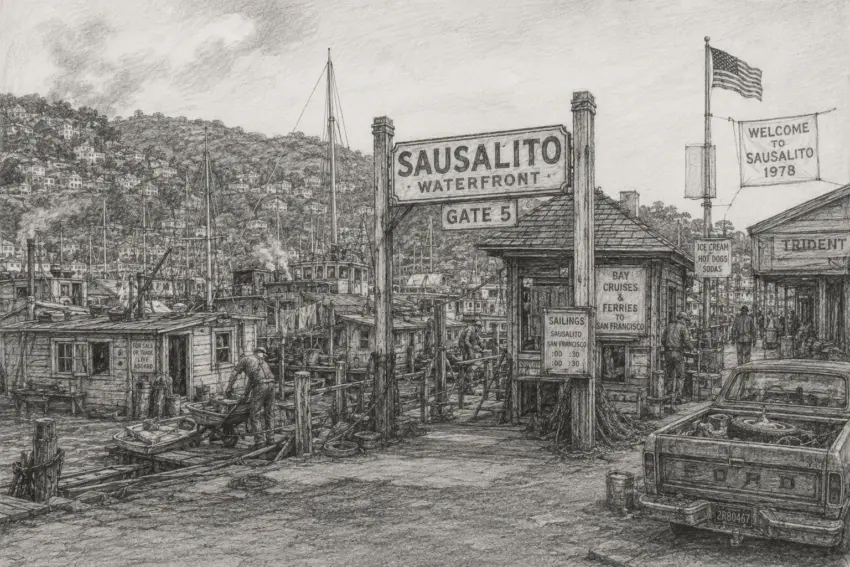
I’ll mostly resist the romance. I spent a fair amount of time on the Gate 5 planks myself in the late 1970s and into the early ’80s, doing boat work along the Sausalito working waterfront, and I had no patience then or now for the version of this story where everyone on the water is an artist and everything they do is sacred. There were days I’d be in the water on a job and watch floaters drift by — that’s what we called them — and not because of any one boat. Sausalito had no honey-barge service, and a lot of what came out of those vessels went straight into the bay. The eelgrass that the Bay Conservation and Development Commission set out to protect is real. Richardson Bay lost a stretch of seafloor “four times the size of Alcatraz” — RBRA’s own phrase — to anchor chains, and the restoration program has put 14 acres back into the water with the final acre due this summer. That is a fraction of what was lost, but it is not nothing, and the divers pulling 4,000 pounds of debris off the bay floor last spring were not chasing a fantasy.
But the people on those boats were not all derelict, and many were not mostly poor. Sausalito’s waterfront has been a refuge for the deliberate non-conformist for as long as anyone reading this has been alive.
Otis Redding wrote “(Sittin’ On) The Dock of the Bay” in August 1967 on a houseboat the rock impresario Bill Graham loaned him at Waldo Point. Three months later he was dead in a plane crash, and the song became the first posthumous No. 1 single in American chart history. Alan Watts kept a share of the old ferryboat SS Vallejo from 1961 until his death in 1973, and the Houseboat Summit he hosted there in 1967 — Timothy Leary, Allen Ginsberg, Gary Snyder, Watts himself — is the document of a particular American moment that could not have happened in a condo. Sterling Hayden, the actor, slipped his schooner Wanderer out of Sausalito at 11 p.m. on January 18, 1959 with his four children aboard in defiance of a custody order, and pointed her at Tahiti. When he came back he tied up at the retired ferryboat Berkeley a few hundred yards away and wrote the book about it. The Gate 5 ferryboat scene that grew up after the war — by the time I got there, in the late ’70s — was a working-class, salvaged, half-built community of welders and painters and writers and people who could not abide a lease, lashed together by planks instead of a street grid, and the whole thing more or less ran on its own logic. There was even a pirate radio station, KMUD, broadcasting out of the mud. Some of those same folks turned up in Garberville a few years later and put a licensed version of KMUD on the air in 1987 — same call letters, possibly the same bootleg transmitter, certainly the same idea. The Garberville KMUD is still there. The mud at Gate 5 isn’t.
That world is essentially gone. Most of the legal floating homes in Sausalito today are six- and seven-figure properties. The unlegal ones — the anchor-outs — were the last freehold along that shoreline, and by mid-October they will be a memory. The people I knew there who held on the longest didn’t stay in the Sausalito they remembered. Some went out to Bolinas — Marin’s last unincorporated holdout, the place Audrey Auld Mezera once sang about as “the edge of the western world, scared men and angry women.” Some went up to Garberville. Some went further still. They went where they could keep being themselves on a smaller budget.
Marin can live with that loss. Marin has been living with it for forty years. The harder question is what is happening to the equivalent corners up here.
Sonoma County had its own version. The Russian River summer-cabin colonies between Forestville and Monte Rio were full of artists, retirees on small pensions, queer households who had washed up there because nobody else would take them, and a comfortable mix of locals who weren’t on anyone’s marketing brochure. The fires accelerated what gentrification had already started. The cabins that didn’t burn became short-term rentals at $400 a night. The rebuilds went bigger and code-compliant and inaccessible. Monte Rio is still itself, mostly, but the edges are thinning. Occidental’s old hippie-punk fringe is mostly memory. Geyserville and Healdsburg have been remade by tasting rooms.
Petaluma still has live-aboards on its river. Bodega Bay still has a few weather-beaten boats whose owners are not exactly carrying a mortgage. Lake County, all of it, remains the cheapest place in the four counties to be unconventional, which is a compliment and a warning at the same time.
And we have homeless people. Sonoma County has them in numbers, in places that look nothing like a houseboat. Earlier this year a fire broke out under the Fife Creek bridge behind the Guerneville Safeway, started by people living there. The official framing for episodes like that tends toward “unhoused individuals,” as though the housing was the only thing missing.
A lot of those folks are the latter-day version of the people in the Sausalito mud. Fiercely independent, often troubled, frequently both — and the framing tends to flatten that. The trouble runs in both directions: homelessness itself is a cause of mental illness and addiction roughly as often as it is a result of them. When you clear an anchorage, gentrify a marina, close a trailer park, you take away the soft place to fall. You may improve the smell. What gets stripped with it is harder to name than the eelgrass: something like the dignity of being allowed to not fit, to make a small life on a margin without having to explain the life to anyone.
What Sausalito’s anchor-out endgame says, when you read it from up here, is that the policy machinery for clearing such places now exists, has been refined, has a model, and has the grant funding behind it. The eelgrass protection zone, the regional joint-powers agency, the housing voucher pipeline, the buyback program, the cease-and-desist agreement with a state commission — all of that is portable. It can be applied wherever a community decides the people on the edge are spoiling the view.
The eelgrass argument was real. It was also useful. The people who own the houses with the views wanted the boats gone too, and the eelgrass gave the policy a defensible language it would not have had on its own. Both things were true at the same time, and pretending otherwise is the part that grates.
I am not arguing the bay shouldn’t have been cleared. The poop alone made the case, and the eelgrass is a real public good. But I would like the next conversation about it, when it comes to a Sonoma County waterway or a stretch of river or a stand of redwoods where a few people are quietly living because they can’t afford to live anywhere else, to be honest about what is being chosen and what is being lost. The eelgrass grows back at 14 acres in five years. The other thing — the corner where the next Otis Redding sits down to write a song nobody has heard yet, the small dignified independence of the person who can’t or won’t fit anywhere else — does not.